Specialist programme
ACL rehabilitation in Swindon
A personalised, criteria-led programme informed by the Melbourne ACL Rehabilitation Guide. Restore movement, rebuild strength and progress towards your activity or sporting goals using clinical tests and readiness checks — not a blanket return timeframe.
Initial assessment £60 (50 min) · Follow-ups £50 (45 min) · Session blocks discounted 5% and 10%
Why criteria beat calendars
Two people six months post-surgery can be in completely different places. Returning because a date has arrived is not enough. We use elements of Randall Cooper and Mick Hughes' Melbourne ACL Rehabilitation Guide 2.0 to assess readiness for the next challenge, with a plan adapted to your graft, other injuries and goals.
You will know your quadriceps strength compared with your other leg, your hop test symmetry, movement quality and confidence. Tissue healing time and your surgeon's advice still matter: passing a test is not permission to skip biological recovery, and symmetry alone can hide weakness in both legs.
- Written stage plan from your first appointment
- Objective strength and hop testing repeated through the programme
- Work that fits around your gym, club or school training
- Communication with your surgeon or consultant where useful
- Clear discharge point with a maintenance plan, not an open-ended diary
Your rehab journey
ACL rehabilitation stages at a glance
01
Pre-op
02
Early recovery
03
Strength
04
Running & jumping
05
Change of direction
06
Return to sport
What happens after ACL reconstruction
Your torn anterior cruciate ligament is replaced with a graft, usually taken from your hamstring, patellar tendon or quadriceps tendon. The graft takes many months to mature, while the muscles around the knee — especially the quadriceps — weaken quickly. Rehab protects the healing graft and rebuilds everything around it.
Early mobility and swelling management
The first weeks set up the rest of your recovery. Getting the knee fully straight early is one of the most important goals, alongside settling swelling and walking normally.
- Full knee straightening matching the other side
- Swelling graded and reduced with load management
- Straight-leg raise without a lag
- Normal walking without crutches when cleared
Quadriceps and hamstring strength
Quadriceps weakness is common after ACL surgery and can last long after the knee feels normal. We progress from activation exercises to heavy, gym-based strength work for the quadriceps and hamstrings — taking into account where your graft was taken from — and measure both legs throughout.
Running, jumping and plyometrics
Running usually begins around three to four months once strength, swelling and hop criteria are met. Jumping and landing drills build from double-leg to single-leg, then into plyometric work that teaches the knee to absorb and produce force quickly.
Change of direction and sport-specific training
Cutting, pivoting, deceleration and reactive drills are added progressively and built around your sport — football, rugby, netball, skiing or anything else — before returning to full team training.
Objective strength, hop and force-plate testing
We test rather than guess. Strength testing, single, triple, crossover and timed hop tests, the Star Excursion Balance Test and VALD ForceDecks jump and landing analysis show how each leg is performing, and are repeated through rehab.
- Limb symmetry targets above 90–95% in later phases
- Movement quality, not just distance or height
- ACL-RSI questionnaire for psychological readiness
Why time since surgery is not enough
Nine to twelve months is a common reference point, but passing time does not guarantee the knee is ready. Return-to-sport decisions combine biological healing time with meeting test criteria, confidence and full training, agreed with you and your surgical team.
Support for the whole journey
We can see you before surgery to prepare the knee, from the first weeks after your operation, part-way through if your rehab has stalled, or just for return-to-sport testing. Patients travel from across Swindon and Wiltshire, including Wroughton, Royal Wootton Bassett, Highworth, Marlborough, Cricklade and Chippenham.
General education, not individual clinical advice. Your surgeon's protocol always comes first.
The programme
A pathway built around readiness
Pre-operative preparation followed by five rehabilitation phases. Tests are selected when clinically appropriate; these are guide elements, not a self-clearance checklist.
Pre-op
Readiness for surgery
Recover movement and build a baseline
Where surgery is planned, settle the knee and restore movement first. Record knee range, swelling and quadriceps and hamstring strength so rehabilitation starts from a clear baseline. Testing is adapted to what the injured knee can safely tolerate.
Phase 1
Recovery from surgery
Restore movement, settle swelling and activate the quad
Use a goniometer to measure knee straightening and bend, a stroke test to grade swelling, and a straight-leg raise to check quadriceps control without an extension lag. The guide includes full extension, at least 125° of flexion and minimal swelling; your surgeon's restrictions take priority.
Phase 2
Strength & neuromuscular control
Build strength and controlled single-leg movement
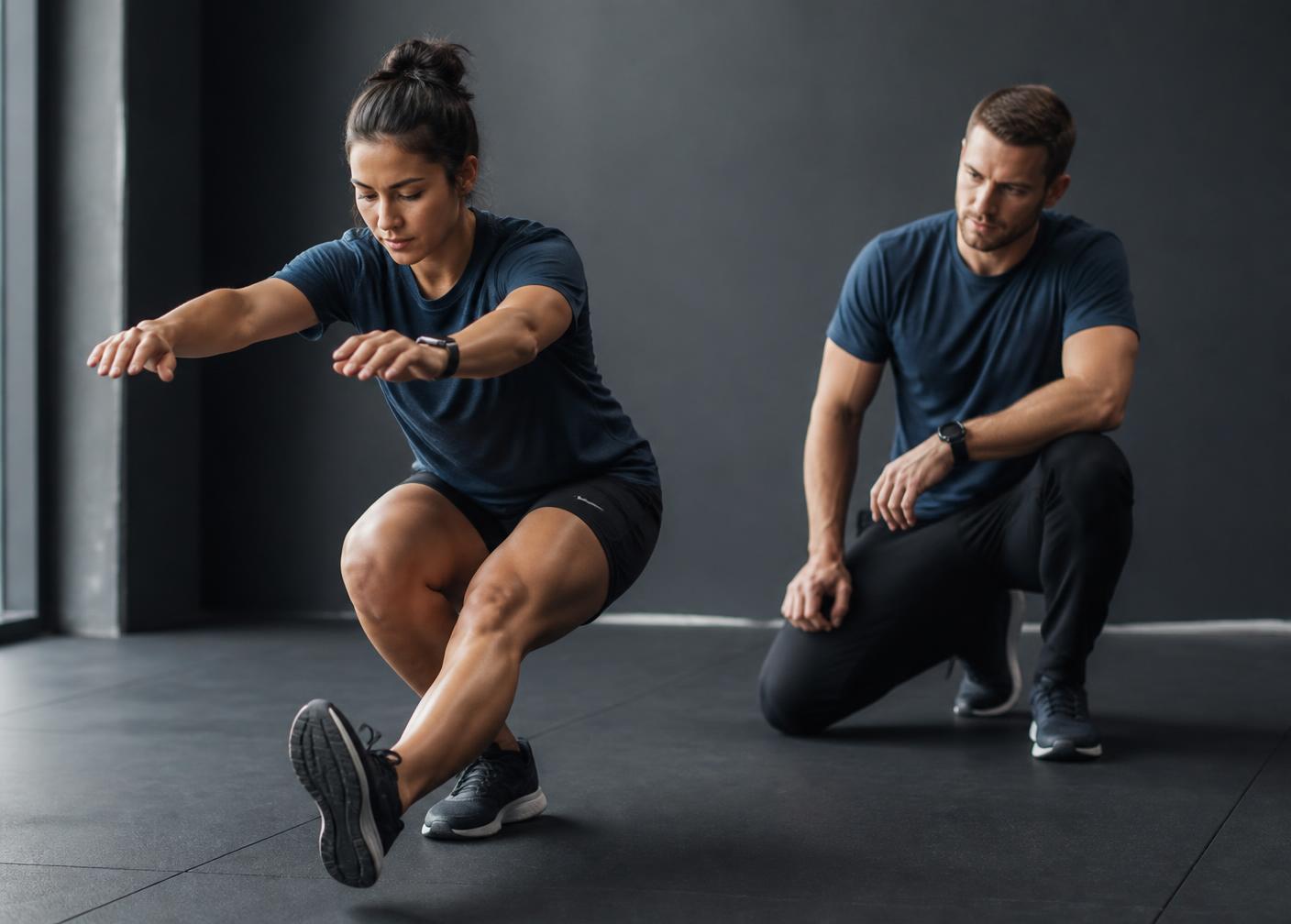
Progressive strength work is paired with the single-leg squat test, single-leg bridge, calf raises, side-bridge endurance and single-leg rise test. We assess balance, trunk and knee control as well as side-to-side performance, rather than assuming a pain-free knee is ready to run.
Phase 3
Running, agility & landings
Reintroduce impact and test how you absorb it
Running, jumping, landing and direction changes are introduced gradually once the knee is ready. The guide uses single, triple, crossover and side-hop tests, plus the Star Excursion Balance Test. Its later phase goals include greater than 95% limb symmetry on hop and balance tests, alongside good movement quality and no swelling.
Phase 4
Return-to-sport readiness
Combine physical tests with confidence and fitness
The Melbourne Return to Sport Score 2.0 brings together clinical examination, functional testing, IKDC knee-function and ACL-RSI psychological-readiness questionnaires, fear-of-movement screening, general fitness and testing under fatigue. Results inform a graded return to training and competition with your treating team — not automatic clearance.
Phase 5
Preventing re-injury
Keep strength and injury-prevention work in your routine
Continue strength, landing and change-of-direction work after returning to activity. Agree a sustainable injury-prevention warm-up, monitor how the knee responds to training and keep building the capacity needed for your sport or everyday goals.
Source: Melbourne ACL Rehabilitation Guide 2.0 — Randall Cooper & Mick Hughes. We use relevant elements of the guide rather than claiming formal accreditation or a guaranteed return date.
Starting at a different point?
Plenty of people come to us mid-way through — discharged from an NHS pathway at three months, stalled at six, or never cleared properly at all. That is a very common starting point and completely workable. We assess where you actually are and rebuild the plan from there.
Tell us where you are in your recovery
Include your surgery date if you have had one, and the sport you want back. Matt will reply with a realistic next step.
Ready to start your ACL rehab properly?
Book a 50-minute initial assessment and leave with a staged plan and your baseline numbers.